Fasting for Weight Loss: What Really Happens to Your Body After 16, 24, and 72 Hours

Updated: Aug 9
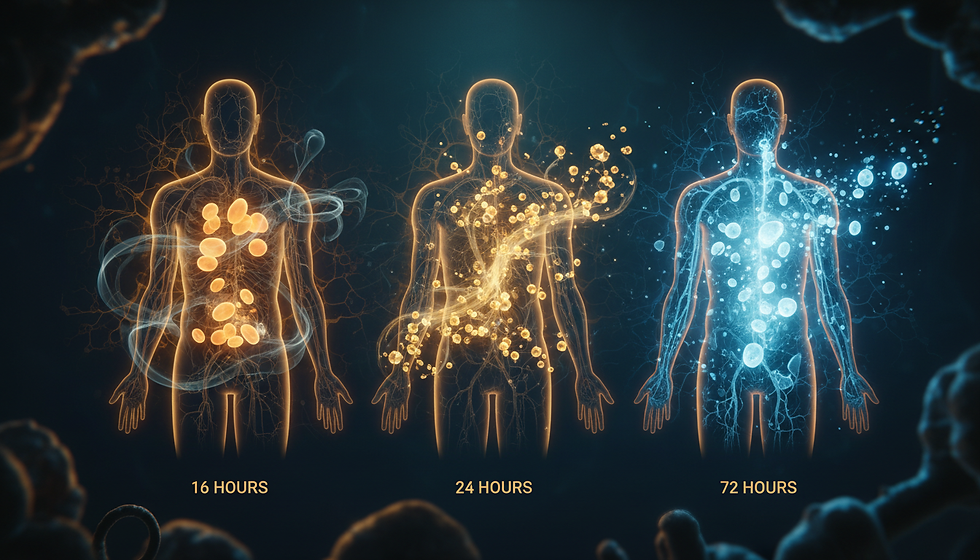
Fasting has moved from ancient practice to modern health strategy—and for good reason. Beyond calorie control, fasting triggers powerful metabolic and cellular changes that support fat loss, improved energy, and better appetite regulation. But what actually happens inside your body as fasting hours increase?
Let’s break down what occurs at 16, 24, and 72 hours, and why many people find fasting to be a reset—not a punishment.
After 16 Hours: The Metabolic Switch
Around the 12–16 hour mark, your body begins to shift from glucose dependence to fat utilization. This transition is often called the metabolic switch.
What’s happening:
Insulin levels drop, allowing fat to be released from storage
Glycogen (stored sugar) becomes depleted
Fat burning and ketone production increase
Hunger often peaks—then begins to stabilize
Many people start intermittent fasting at this stage because it delivers benefits without extreme discomfort. You may notice clearer thinking, reduced bloating, and more stable energy once the body adapts.
Key takeaway: This is where weight loss begins to feel effortless instead of forced.
After 24 Hours: Autophagy Turns On
At roughly 24 hours, the body enters a deeper state of repair through a process called autophagy—your body’s built-in recycling system.
What’s happening:
Damaged cells are broken down and replaced
Inflammation decreases
Insulin sensitivity improves
Fat burning accelerates
Autophagy is one reason fasting supports long-term health beyond the scale. By clearing out inefficient cellular components, your body becomes more metabolically efficient.
Hunger often drops at this stage, surprising many first-time fasters. Energy can feel steady, and mental clarity often improves.
Key takeaway: Weight loss is no longer just about burning calories—it’s about cellular renewal.

After 72 Hours: Deep Reset Mode
Extended fasts such as 72 hours are not for everyone and should be approached intentionally. However, they represent a deep metabolic and cellular reset.
What’s happening:
Autophagy increases significantly
The body relies almost entirely on fat and ketones
Inflammation markers drop further
Appetite hormones begin to reset
Many people report a dramatic shift in their relationship with hunger after longer fasts. Cravings fade, and true hunger becomes easier to recognize. This is why some individuals use extended fasting as a periodic reset, not a regular routine.
Important note: Hydration, electrolytes, and proper support are essential at this stage.
Key takeaway: Extended fasting can recalibrate appetite, metabolism, and energy—when done safely.
Why Fasting Supports Sustainable Weight Loss
Unlike traditional dieting, fasting works with your biology instead of against it.
Fasting helps you:
Lower insulin naturally
Access stored body fat
Reduce constant hunger signals
Improve metabolic flexibility
Over time, you stop grazing out of habit and begin eating with intention.
Supporting Your Fast (Without Breaking It)
One of the biggest challenges with fasting—especially in the early stages—is managing hunger, energy, and stress.
This is where supportive tools can make a difference.
Some people use The Fast Patch, a discreet, non-oral patch designed to help:
Curb appetite
Promote calm
Support steady energy during fasts
Because it’s easy to use and doesn’t require pills or powders, many find it helpful during longer fasting windows or water fasts—especially when adjusting to a new routine.
The goal isn’t to “push harder,” but to make fasting sustainable.
A New Perspective on Hunger
Perhaps the most powerful benefit of fasting is awareness.
You begin to recognize:
Habit hunger vs. real hunger
Emotional cravings vs. physical need
Energy stability without constant eating

This shift alone can transform how you approach food long after the fast ends.
Fasting isn’t about deprivation—it’s about giving your body the space to do what it was designed to do.
Whether you start with 16 hours or explore longer fasts, the real benefit comes from consistency, education, and support.
When done intentionally, fasting becomes less about weight loss—and more about reclaiming control over your health from the inside out.


Comments